
01
Speak
Tap the mic and talk for forty-two seconds. About your day, a feeling, a memory — whatever's on your mind.
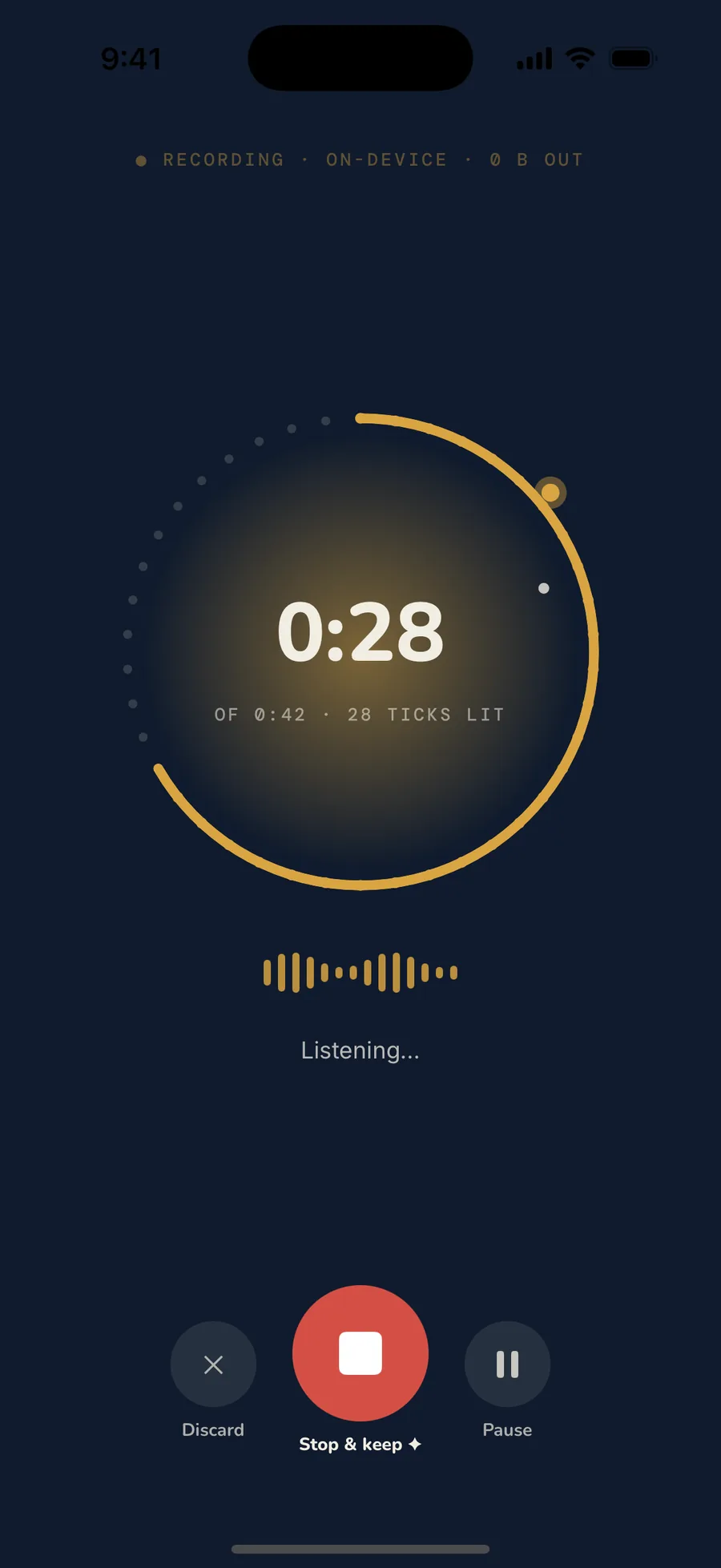
Your voice is transcribed on-device.
Your voice. Your mirror. Yours alone.
The mic is the whole interface — no prompt, no blank page, nothing to fill in.
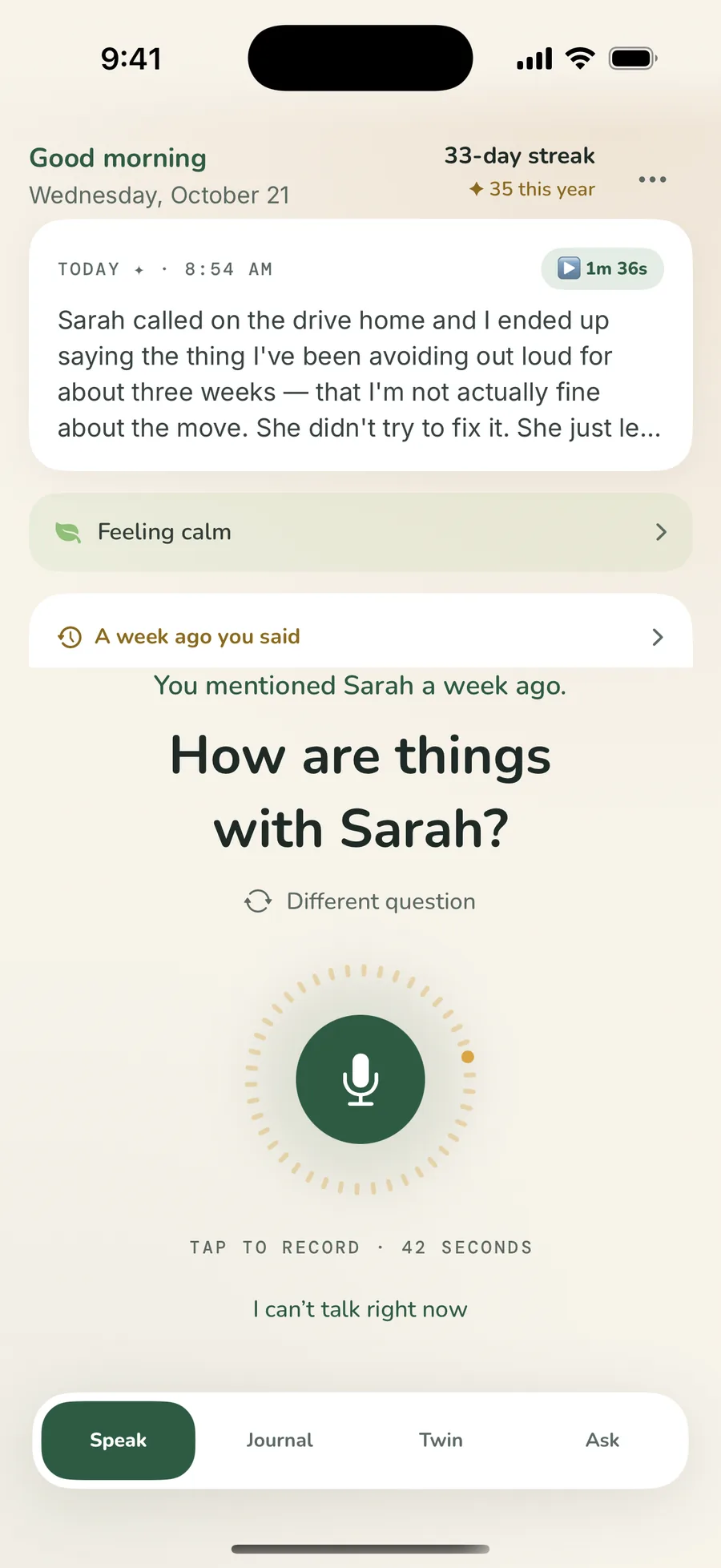
Transcribed by the phone that heard them. Nothing is uploaded, then or later.
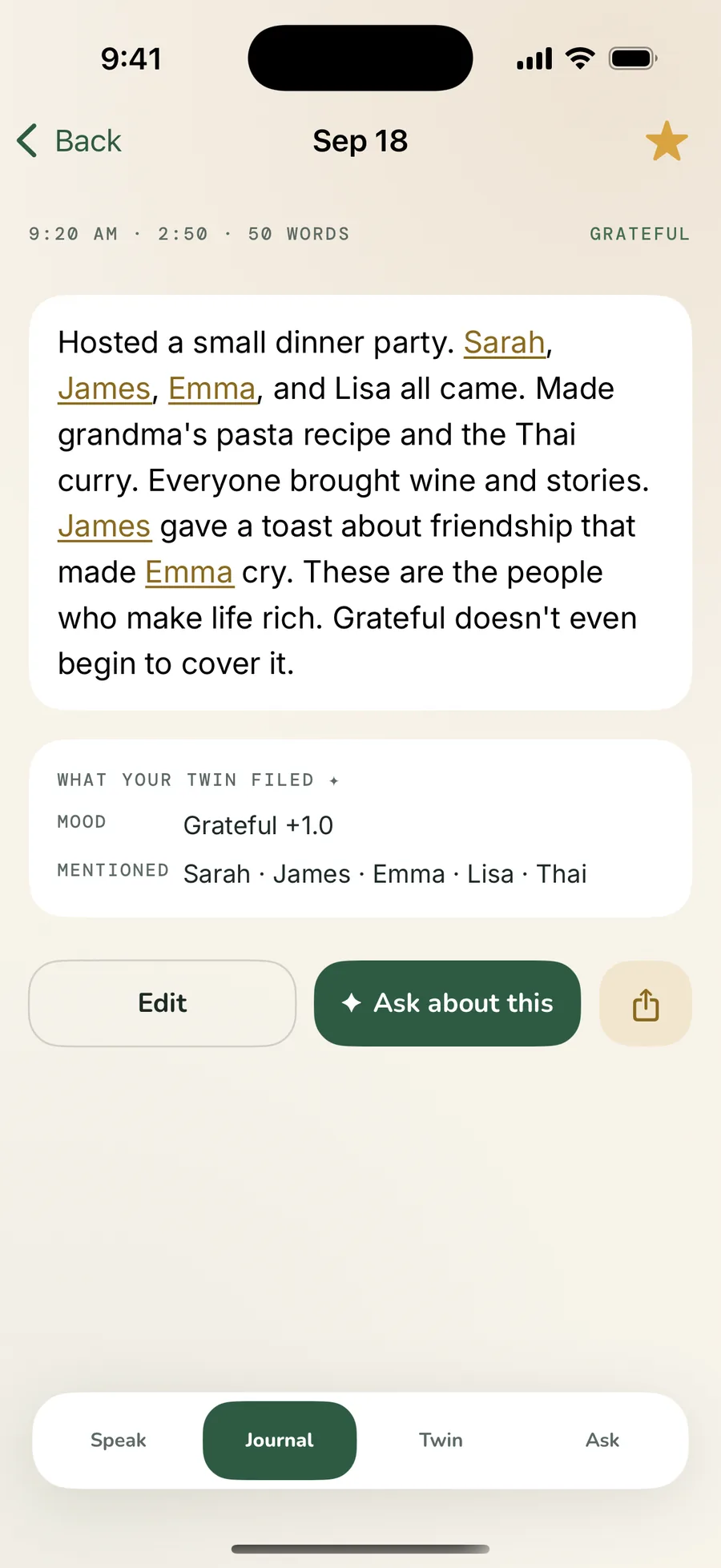
Your Twin files what it just learned against every entry before it.
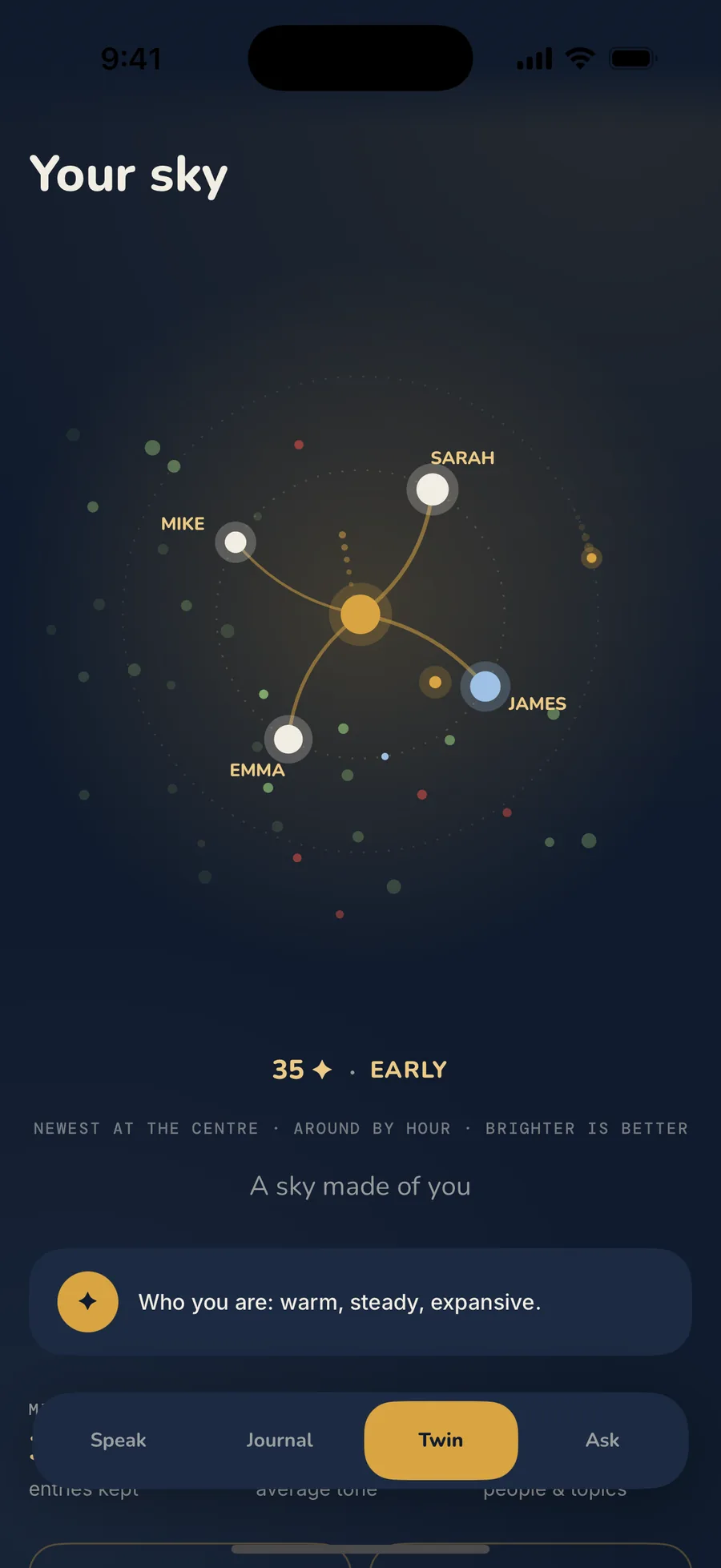
Forty-two seconds. Tomorrow it knows more again.
DailyVox is a free voice journal for iPhone and Android with on-device AI. Speak for forty-two seconds — or longer. The app transcribes your voice on-device and builds a Digital Twin, an AI model of your personality and inner world. It lives on your phone. It never leaves. It's yours. See how the on-device AI journaling app works →
how it works
No typing. No prompts. No setup. Just speak — and your Twin takes shape.
Tap the mic and talk for forty-two seconds. About your day, a feeling, a memory — whatever's on your mind.
Your voice is transcribed on-device.
Every entry feeds your Digital Twin — a private model of your personality, emotions, and the people and topics in your life.
It lives on your phone.
Over days and weeks, your Twin reveals mood trends, predicts emotional shifts, and answers questions about who you are.
The longer you journal, the deeper it sees.
the vision
Your Digital Twin is a mirror built from your own words — not an oracle. It remembers everything you've shared. It sees patterns you can't. Over time, it learns how you think, how you feel, and who you mention, and it forecasts your mood from your own past patterns. It even tells you how well it knows you — Twin Resolution is a measured score, not a promise. And it runs entirely on your phone — private, permanent, yours alone. What is a personal digital twin? →
Communication style, formality, reflection depth — measured across every entry.
Emotional patterns, mood baselines, triggers — tracked over time with sentiment analysis.
People, places, topics — a knowledge graph of everything that matters to you.
Mood forecasting using temporal, linguistic, and topic patterns from your past entries.
Not a chatbot. Not a prompt tool. A private, evolving model of who you are.
meet your Twin
Your Twin isn't one model — it's a constellation of dimensions. Mind for how you think, Voice for how you speak, Heart for how you feel, and a Graph of who and what you mention. In v1.5 a fifth dimension joined them — Body, layering sleep, HRV, and movement context underneath your words. Below it all, a forecast of where you're headed.
How you think — reflection, openness, and formality, traced across cognitive bands.
How you speak — rhythm, tone, and pace, measured as a live acoustic fingerprint.
How you feel — valence and arousal, rendered as a breathing field of colour.
Who and what you mention — weighted by how you feel when you mention them.
How your body is — sleep last night, morning HRV, resting heart rate, and the activity context around each entry.
Pulled from Apple Health on iPhone; sampled live during the recording on Apple Watch — but only when you're at rest, so a jog isn't mistaken for emotional stress. Every entry gets a body_context tag (at_rest / active / post_workout) so the Twin knows how to read it.
on-device only · "Data Not Collected" label preserved
A forecast across your last seven days.
Tomorrow · +0.58 · leaning positive.
how it learns
Every journal entry flows through the same on-device pipeline. Select any stage to see what happens to your data at each step. (And nothing leaves the phone.)
stage 01 · capture
AVAudioEngine captures AAC audio at 44.1 kHz directly from the iPhone microphone. The buffer is held in memory and handed to the transcriber — never uploaded, never cached to disk.
stage 02 · transcribe
SFSpeechRecognizer turns your audio into text with requiresOnDeviceRecognition = true — no server round-trip, in 60+ languages.
stage 03 · analyse
NLTagger extracts sentiment, named entities, and parts of speech using four CoreML models — every signal computed on your phone.
stage 04 · model
The TwinEngine updates every dimension — Mind, Voice, Heart, Graph, Body — and recomputes the mood forecast. All math happens in memory, on-device.
stage 05 · persist
Core Data stores the entry and the Twin's AIState in local SQLite. Optional sync is end-to-end-encrypted through your own iCloud — never readable by us.
your data shield
Attach a network proxy during a 2-minute voice entry. Run the transcription, NLP, and Twin update. Zero bytes leave the device.
Every AI operation runs on the phone itself, iPhone or Android. Zero outbound requests, ever.
No analytics, crash reporting, or ad SDKs. Platform frameworks only, on both phones.
GCM authenticated encryption for backups, in one format that opens on iPhone and Android.
"Data Not Collected" on the App Store. No data collected or shared on Google Play.
✦ your constellation is shielded
new · android 1.1
Same journal, same Twin, same rule. The Android app requests no internet permission at all, so an entry has no route off the phone. You can check that in Android's own Settings › Apps › DailyVox › Permissions, without trusting a word of this page.
Android's own permission screen lists the microphone and notifications. Nothing else. The operating system refuses a network connection on our behalf.
Where the on-device speech recogniser arrived. DailyVox never transcribes over a network instead.
Android Auto Backup is switched off, so the system never copies your journal to the cloud.
An encrypted backup made on Android opens on an iPhone, and the other way round.
No AI chat, health data or photos yet, and English only. The roadmap lists what comes next.
why voice
When you type, you edit. When you speak, you think out loud. Voice journaling captures more of who you actually are — unfiltered, unpolished, real.
Speaking at 150 WPM vs typing at 40. More thoughts captured in less time.
No cursor. No blinking prompt. Just press record and start talking.
Less than a minute, and enough for a meaningful entry — yet you can speak as long as you like.
the stack
DailyVox is built entirely on platform SDKs — Apple's frameworks on iPhone, Google and AOSP frameworks on Android. There are no third-party dependencies anywhere in the app, on either side. Every capability has a home inside the operating system it runs on.
| Capability | iPhone | Android |
|---|---|---|
| Transcription | SpeechAnalyzer · SFSpeechRecognizer | The phone's own on-device recogniser |
| Sentiment & entities | NLTagger · four CoreML models | Bundled VADER lexicon · capitalisation heuristic |
| Search | NLEmbedding · 512-dim vectors | Journal search, typed or by voice |
| Conversational Twin | Foundation Models · 3B on-device LLM | Not in v1.1 — Ask answers from your entries and names the ones it used |
| Body signals | HealthKit · Apple Watch | Not in v1.1 |
| Storage & sync | Core Data + CloudKit, end-to-end | Room, on the phone only · encrypted backup file |
| Lock & keys | Face ID · Secure Enclave | BiometricPrompt · fingerprint, face or PIN |
| Widgets & assistant | WidgetKit · App Intents · Siri | Home-screen widget · Quick Settings tile |
The Android column describes version 1.0, live on Google Play for Android 13 or newer; it requests no internet permission at all. The iPhone column is what ships on the App Store, and every framework in it is listed below with the version it arrived in.
On-device transcription with requiresOnDeviceRecognition = true. 60+ languages on the Neural Engine.
Sentiment scoring, Named Entity Recognition, part-of-speech, and language identification — four CoreML models running locally.
v1.0 · iOS 12+Dense sentence embeddings power on-device semantic search — find an entry by meaning, not keywords.
v1.6 · iOS 17+LanguageModelSession with tool calling and @Generable structured, citation-constrained answers. Live in v1.7 on Apple Intelligence iPhones.
Replaced SFSpeechRecognizer in v1.6 on iOS 26+ (earlier iOS keeps the on-device recognizer). Lower latency, native long-form support.
v1.6 · iOS 26Local SQLite with optional end-to-end-encrypted sync. The Twin is one AIState Codable JSON entity.
Authenticated encryption for backup exports. Passphrase-derived keys for device migration.
v1.0 · iOS 13+Biometric gating on every journal access. Keys stored in the Secure Enclave — never extracted.
v1.0 · iOS 11+Home & Lock-screen widgets. AppIntents-powered Siri shortcuts for hands-free entries.
v1.0 · iOS 16+next to the category
| Feature | DailyVox | Day One | Reflectly | Apple Journal | Rosebud |
|---|---|---|---|---|---|
| price | free forever | $49.99/yr | $59.99/yr | free | $12.99/mo |
| voice journaling | ✓ | cloud | limited | basic | ✓ |
| on-device AI | ✓ | partial | — | partial | — |
| Twin · chat + predictions | ✓ | — | — | — | — |
| works offline | ✓ | partial | — | ✓ | — |
| data collected | none | yes | yes | minimal | yes |
| account required | no | yes | yes | no | yes |
| open-source app | ✓ | — | — | — | — |
the roadmap
Your Twin already predicts, converses, and shares — and every feature below runs on-device. No cloud. No compromise.
Your Twin anticipates mood shifts, identifies emotional triggers, and detects temporal patterns — day-of-week, seasonal, and trend-based.
Have a conversation with your Digital Twin. Ask it questions about your patterns, moods, and personality — entirely on-device.
Share your Twin's personality snapshot as beautiful cards — optimized for Instagram Stories and Twitter/X.
Sleep, HRV, resting heart rate, and activity context feed the Twin — every signal through a review-and-discard queue, context-aware so a jog isn't mistaken for stress. The Apple Watch companion is a later Body Twin release.
Find entries by meaning, not keywords — 512-dimensional on-device embeddings with a measured abstention threshold, so search declines rather than guesses. The grounding layer for the v1.7 conversational Twin.
A 3B on-device LLM powers deep conversations with your Twin, with answers that cite your own entries. Then v2.0 goes Apple Intelligence native: ask Siri and it consults your Twin — context flows in, nothing flows out.
The same core — forty-two seconds of voice, an on-device transcript, mood, the Twin's constellation of people, Insights and Ask your Twin — on Android 13 or newer. The app requests no internet permission, and Android's automatic backup is disabled so the journal is not copied to Google Drive. English only for now, and no on-device chat or health data yet. Get it on Google Play →
After years of entries: a Twin that talks like you, sounds like you, and knows how you've changed. Not a clone — a mirror that deepens every day.
common questions
Yes. Every feature, forever. No paywall, no premium tier, no "free trial." DailyVox is free and open-source.
No. No signup, no email, no password. Install and start talking. Your data lives on your device, not on our servers — because we don't have servers.
They're transcribed by Apple's speech engine, on your phone. The audio is stored locally. Nothing is uploaded, ever. Run a network proxy during a recording and see for yourself — zero bytes leave the device.
DailyVox is voice-first with an on-device AI that builds a Digital Twin of your personality. Day One is cloud-based and text-focused. Apple Journal has no AI. Neither has a Twin that learns who you are.
Nothing happens. No streaks broken, no guilt trips. Your Twin is patient — it picks up right where you left off.
Yes. PDF, JSON, Markdown, CSV, or AES-256 encrypted backups. Your data is yours — always portable, never locked in.
note from the builder
I wrote a diary for twenty years. Then I couldn't anymore. So I stopped writing — and started talking. That's how DailyVox was born, and why it runs entirely on your phone instead of someone else's server.
Every voice-journaling app I could find shipped audio to a cloud for transcription. I didn't want my most private thoughts processed by a third party, and I didn't want to pay a subscription for it either. So I built my own — free, open-source, fully on-device. The Digital Twin is the next step: a model of you that lives on your phone, not on somebody's server.
from the journal
Inside the TwinEngine — how NLTagger signals become a multi-dimensional personality model, on-device.
read →If the app needs the cloud to transcribe, it isn't private. The on-device test — and how to run it yourself.
read →Seven voice journaling apps compared on privacy, on-device AI, offline support, and price — updated for July 2026.
read →stay in the loop
Monthly updates on on-device AI, Digital Twin features, and voice journaling research. No spam. Unsubscribe anytime.
✦ You're on the list — check your inbox to confirm.
We don't track opens or clicks. Your email is never shared.
install · $0 · no account
Forty-two seconds a day. Your voice becomes a Digital Twin — a private AI that knows how you think, how you feel, and who matters to you. Free forever. No data ever leaves your phone.